
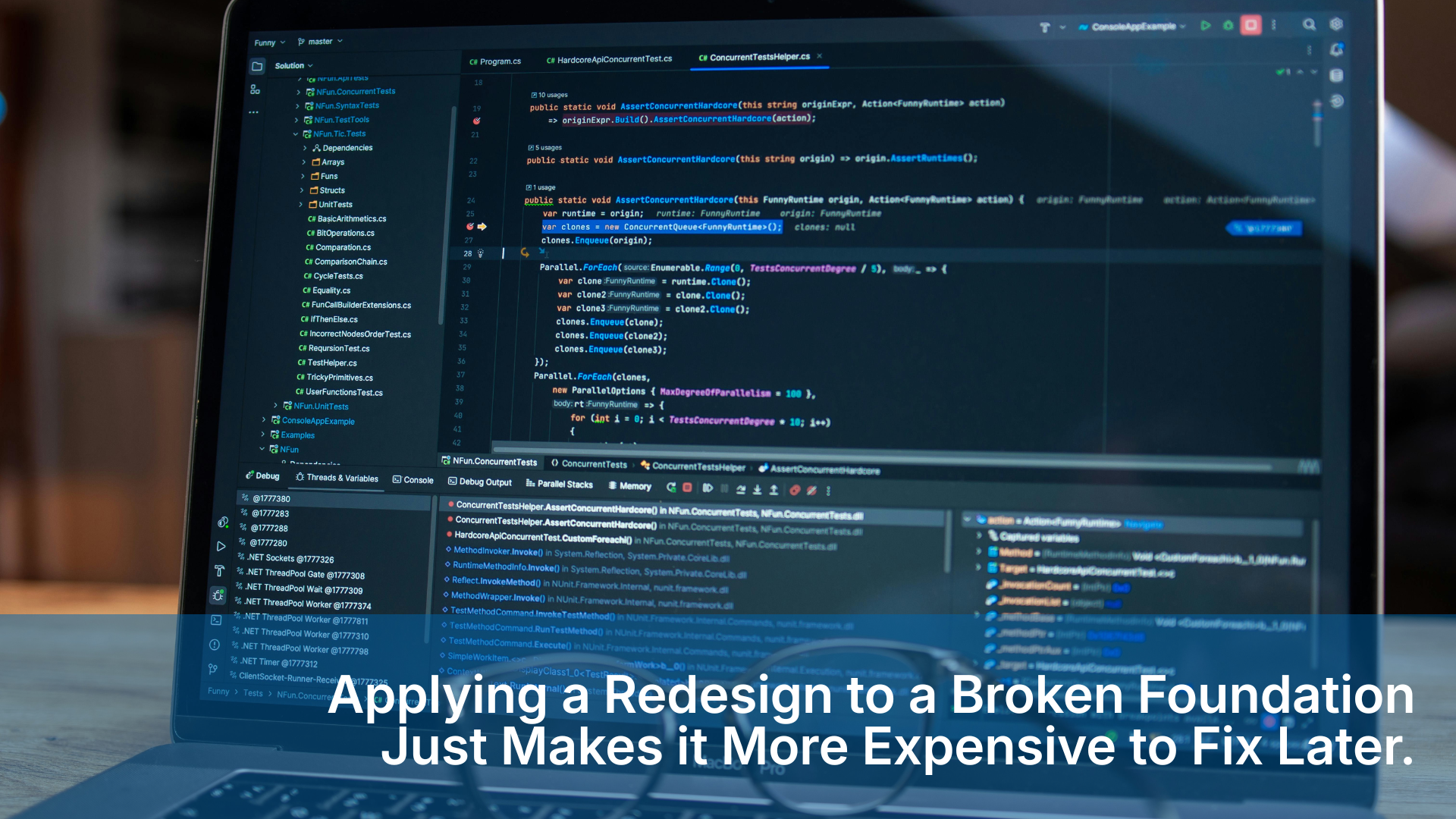
Software doesn’t just age. It depreciates.
A system that served your organization well three years ago was built around the assumptions, data volumes, user expectations, and technology landscape of three years ago.
As each of those things changes — and in 2026, they are changing faster than at any previous point — the gap between what your software was designed to do and what your business now needs it to do grows quietly wider.
Performance slows. Workarounds accumulate. Talented developers spend their time maintaining constraints rather than building capabilities.
And at some point, the system that was supposed to enable your growth starts to limit it instead.
When that moment arrives, every CTO and product owner faces the same fundamental question: do we redesign what we have, or do we rebuild from the ground up?
It is one of the most consequential IT investment decisions a business can make — and the cost of answering it wrong runs in both directions.
What a Redesign Actually Is — and When It Is the Right Answer
A software redesign addresses the layers of a system that users interact with directly: the interface, the experience, the workflows, and the integrations that connect your product to the tools around it.
It improves how the system looks, how it behaves, and how efficiently it guides users through the tasks it was built to support — without touching the underlying code architecture or database structure that powers it.
This is not a superficial exercise. A well-executed redesign can dramatically improve conversion rates, reduce user error, and accelerate onboarding.
When the core architecture of a system is genuinely sound, a redesign is often the highest-ROI modernization path available.
What a Rebuild Actually Is — and When It Becomes Necessary
A rebuild is a fundamentally different undertaking. It means re-architecting the entire application from the ground up.
The decision to rebuild is rarely made eagerly. It represents a significant capital commitment and a development timeline that typically runs between six and eighteen months.
When the system is built on outdated architecture or cannot support modern requirements, a redesign is no longer sufficient.
In these cases, continuing to patch the system becomes more expensive than rebuilding it correctly.
The Decision Framework: Four Factors That Tell You Where You Stand
Choosing between a redesign and a rebuild is not instinctual. It requires structured evaluation.
| Factor | Redesign | Rebuild |
|---|---|---|
| Budget | Moderate — high impact for lower spend | High — requires significant capital investment |
| Timeline | Short — fast iterations and deployments | Long — typically 6–18 months |
| Tech Debt | Surface level — UI and usability issues | Structural — full architectural overhaul |
| Scalability | Limited — constrained by existing architecture | Unlimited — built for future growth and AI integration |
The Business Cost of Choosing Wrong
A rebuild applied unnecessarily wastes capital and delays value delivery. A redesign applied to a system that needs a rebuild allows structural problems to compound silently beneath the surface. In both cases, misdiagnosis is the real cost driver — not the solution itself.
Conclusion
The decision between redesign and rebuild is ultimately a diagnostic problem, not a preference problem. The organizations that modernize successfully are those that invest in understanding where the problem actually lives before committing resources to solving it.
Not Sure Whether You Need a Redesign or a Rebuild?
At Solutions Resource, we help businesses evaluate their systems through structured technical and UX audits.
This allows you to determine the most cost-effective modernization path based on actual system constraints rather than assumptions.
Book a free modernization strategy session with Solutions Resource to identify the right direction for your system.

 By
By
 By
By


 By
By